

At a glance
- Check the folded frame in a physical sample; reference case dimensions do not confirm internal fit.
- Choose the structure, covering, lining and logo process as separate parts of the specification.
- Confirm the order conditions for each model and version before approving production.
Start with the folded frame
A case that looks right in a photograph may still be too small for your eyewear. Measure the maximum length, width and height of the folded frame. Note anything that needs extra clearance, such as thick temples, raised nose pads or a wrapped front.
Published case dimensions are a reference, not a guarantee of usable internal space. Lining, seams and the closure take up room. If the measurement basis is unclear, ask what was measured rather than assuming the figures describe the interior. Test a representative frame in a physical sample and check that it can be inserted, closed and removed without force.
If your collection includes several frame shapes, check more than one. A case that fits a slim optical frame may not suit larger sunglasses. Record which frames were used for sample approval so the same checks can be repeated on a reorder.
Shortlist the right construction
Choose the format around how the case will be used, carried and presented. Compare the open and closed views before deciding which samples to request.
| Format | What to compare |
|---|---|
| Hard eyeglass case | Interior clearance, lining, opening and contact points around the frame. |
| Foldable case | Panel construction, folding action and the case in both its open and closed positions. |
| Zip-around case | Zipper path, opening clearance and the position of the frame inside. |
| Soft case or pouch | Fabric, seams, opening and ease of inserting and removing the eyewear. |
| Multi-pair organizer | Compartment spacing, access and fit for the largest intended frame. |
Browse our eyewear cases, soft eyeglass cases and multi-pair storage to build a shortlist. A category name alone does not establish a model's protection or performance.
Have a model or reference in mind?
Review your project with our team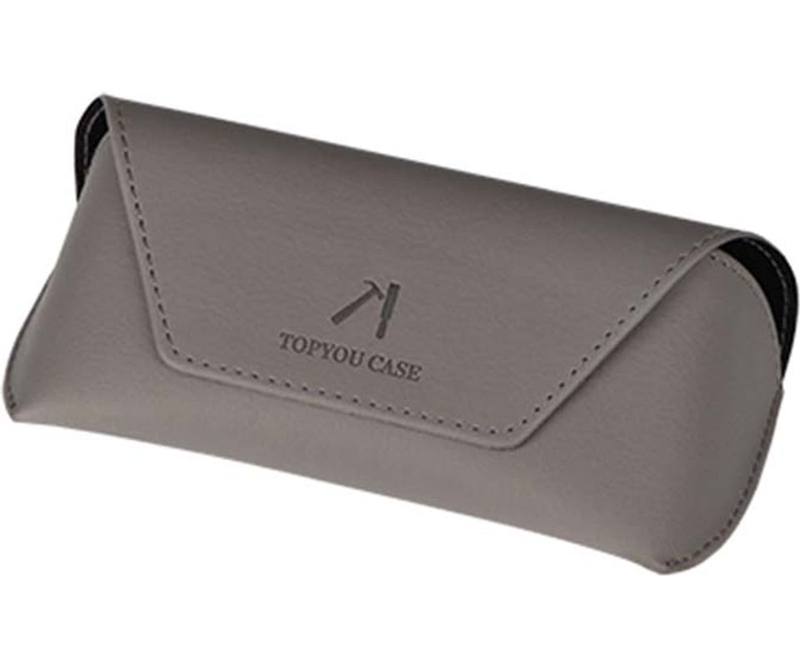
Specify materials and branding together
The case structure, exterior covering and lining are separate choices. Select the model first, then discuss suitable materials and the logo process. Share editable artwork where available, along with the intended logo size and position.
Review the design on the chosen surface. Small lettering, fine lines, textured coverings and curved areas may need different artwork or process settings. Use material cards, Pantone references, foil cards or a customer-supplied physical sample to explain the appearance you want. The approved sample and written specification record the final choice.
Check quantities and timing for the selected model
Selected small-batch styles, standard custom production and ready-to-ship items have different order conditions. Check quantities by model, color and artwork version; the lowest MOQ on one product does not apply automatically to every material or design.
For example, ST212 has a selected small-batch option as well as a standard custom-production reference. B1005-12 is part of a listed ready-to-ship selection. Confirm the current conditions for the exact model you want.
Sampling time depends on the product, materials, artwork and finishes. Typical bulk production is 45–60 days after confirmation, with the final schedule stated in the quotation. Allow separately for sampling and transit, and tell the team your target arrival date.
Use a clear sample-approval checklist
Before approval, check:
- Fit with the intended frames, including insertion, closure and removal.
- Lining, seams and the areas that contact the eyewear.
- Exterior material, color and finish against the agreed references.
- Logo size, position and appearance on the finished surface.
- The case inside its individual packing, box or complete packaging set.
- The model, version quantities, artwork revision and production schedule.
Record any changes before giving approval. For a quotation, send the preferred model or format, frame dimensions, quantity, material direction, artwork, delivery country and target timing. Our development process explains the next steps.